Deriving semantics from pragmatics

Kris Brown

Press s for speaker notes, q to reveal hidden slides

9/3/26

Background (1/6)

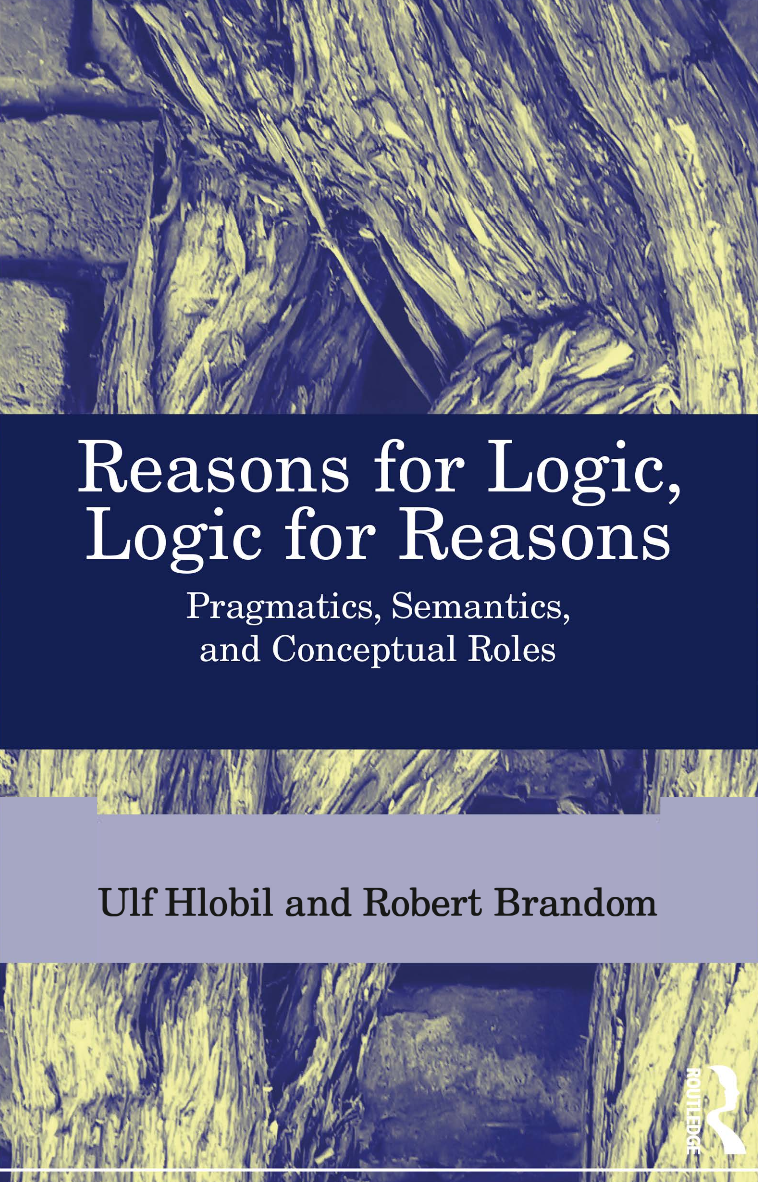
            (2025)

Robert Brandom

          Ulf Hlobil

Project Timeline

  • 2024: Formal pragmatics \to semantics construction for propositional logics

Background (2/6): semantics

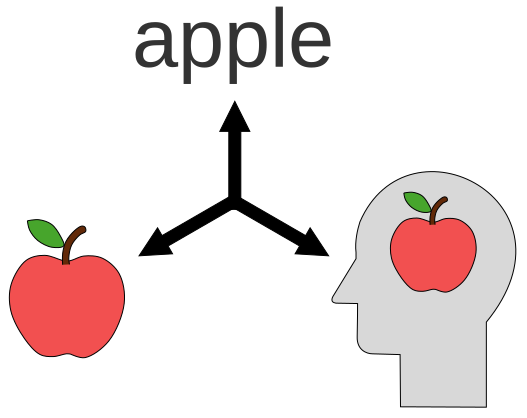
Competing strategies for understanding the meanings of our ordinary language:

The semantic attitude

Bits of language have meaning by referring to the world.


One possibility:

  • particular nouns pick out objects (from some set of ‘real-world objects’)
  • adjectives pick out subsets of objects (i.e. predicates)
  • sentences pick out subsets of possible worlds (the worlds in which they’re true)
  • and picks out the intersection of such subsets

Background (3/6): semantic analysis example


[\![ \text{Amy is poor and honest} ]\!] \\ [\![ \text{Amy is poor} ]\!] [\![ \text{and} ]\!] [\![ \text{Amy is honest} ]\!] \\ \underset{\rm Predicate}{\underbrace{{[\![ \text{Poor} ]\!]}}}(\underset{\rm Object}{\underbrace{{[\![ {\text{Amy}} ]\!]}}}) \underset{\rm Connective}{\underbrace{\raisebox{-1mm}{$\cap$}}} \underset{\rm Predicate}{\underbrace{{[\![ \text{Honest} ]\!]}}}(\underset{\rm Object}{\underbrace{{[\![ {\text{Amy}} ]\!]}}})\\


\text{As conjunctions: }[\![ \text{and} ]\!]=[\![ \text{but} ]\!] = \cap [\![ \text{Amy is poor and honest} ]\!] = [\![ \text{Amy is poor but honest} ]\!] [\![ \text{Amy is poor and honest} ]\!] \vDash [\![ \phi ]\!] \quad \text{ iff }\quad [\![ \text{Amy is poor but honest} ]\!]\vDash [\![ \phi ]\!]

Upshot: semantic attitude accounts for compositionality of natural language

Background (4/6): pragmatics

The pragmatic attitude

To say something is to do something, a speech act.

The meanings of speech acts are to be read off of their consequences.


  • E.g. “Court is in session” not a description of the court
  • E.g. propriety of a chess move not justified by reference.
    • Some particular knight movement allowed because we have agreed on the valid moves.

A notion of consequence from pragmatic raw materials (Restall 2005)

  • Assume we have at least two specific kinds of speech acts: assertion and denial.
  • Assume a normative status ‘impropriety’, e.g. {\rm Improper}(A^+) means it’s improper to assert A.
  • {\rm Improper}(A^+,\ B^-) \ \ \equiv\ \ A \vdash B\ \ \equiv\ \ B\text{ follows from }A \ \ \equiv \ \ A \text{ is a reason for }B

Background (5/6): semantics versus pragmatics

Competing strategies for understanding the meanings of our ordinary language:

The semantic attitude

Language has meaning by referring to the world.


The pragmatic attitude

To say something is to do something (speech act).

Meanings are to be read off of the consequences.


\text{When all goes well: }\quad [\![ A ]\!]\vDash [\![ B ]\!] \quad \text{ iff } \quad A \vdash B

\text{However: }\quad [\![ \text{Amy is poor but honest} ]\!]\nvDash [\![ \text{Wealth+honesty are related} ]\!]

\quad \ \text{... yet: } \quad [\![ \text{Amy is poor but honest} ]\!]\vdash [\![ \text{Wealth+honesty are related} ]\!]

Background (6/6): project timeline

  • 2024: Formal pragmatics \to semantics construction for propositional logics

Problems

  1. Concise presentation of the technical formalism, showing design decisions as ‘natural’
  2. Generalization to syntax with subsentential structure (e.g. predicate logic)

Background (6/6): project timeline

Project Timeline

  • 2024: Formal pragmatics \to semantics construction for propositional logics

  • 2025: Described as the \eta of an adjunction involving simple, commonplace categories.

  • 2026: Generalized internally to any \mathcal{E} (some fixed topos with a natural numbers object)

  • 2026: Instantiate \mathcal{E}\mapsto \mathsf{Nom}, use particularities of nominal sets to address predicate logic.

Technical Outline

  1. Internal (pointed, Girard) quantales

  2. The ‘free sequent-set’ functor

  3. Implication frames + the logical completion

  4. Interpreting MALL and classical logic in a frame

  5. Work in progress: Nominal sets to model subsentential structure

Quantales internal to a topos (1/4)

A (commutative, unital) quantale is a complete lattice with a (commutative, unital) multiplication \otimes such that: a \otimes \bigvee_i b_i = \bigvee_i a\otimes b_i.

Internal suplattices in a topos

An internal suplattice in a topos \mathcal{E} is an object X equipped with a join operation \bigvee\colon \mathcal{P}X \to X.1

Internal quantale in a topos (1/2)

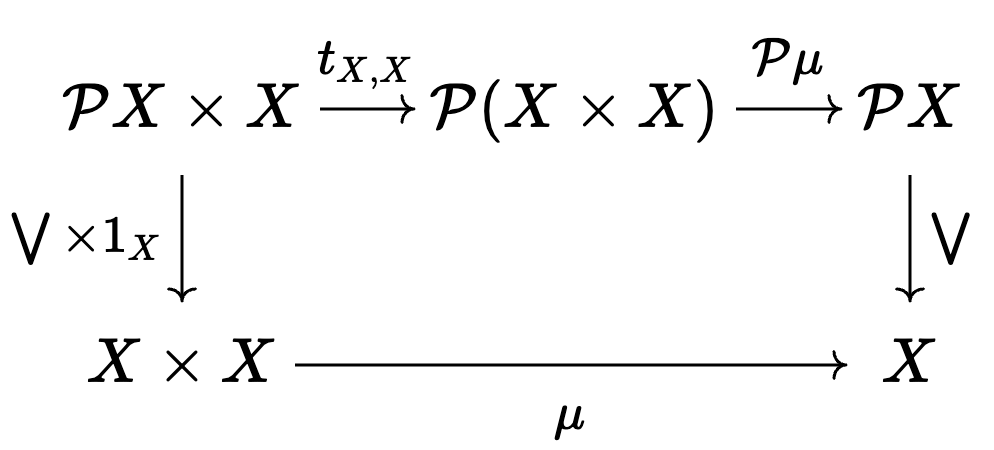
A (commutative, unital) internal quantale is an internal commutative monoid (X, \mu, e) and internal suplattice (X, \bigvee) structure, satisfying:

Quantales internal to a topos (2/4)

Internal quantale in a topos (1/2)

A (commutative, unital) internal quantale is an internal commutative monoid (X, \mu, e) and internal suplattice (X, \bigvee) structure, satisfying:


Example: lifting monoid structure on X to quantale product on \mathcal{P}X

If (X,+,0), then (\mathcal{P}X,\bigcup, \otimes_{\rm Mink},\{0\}) is an internal quantale.

A \otimes_{\rm Mink} B = \{a+b\ |\ a \in A, b\in B\}

Quantales internal to a topos (3/4)

Residuation morphism

Suppose we have a distinguished point: I\colon 1\to Q.

There is a residuation morphism (-)^*\colon \mathcal{Q}\to \mathcal{Q} given by q \mapsto \bigvee \{x\ |\ x\otimes q \leq I\}.1


These residuation morphisms have nice properties.

Closure operation

(-)^{**} is a \mathsf{Quant}_\mathcal{E} endomorphism and closure (idempotent, increasing) operation.

Quantales internal to a topos (4/4)

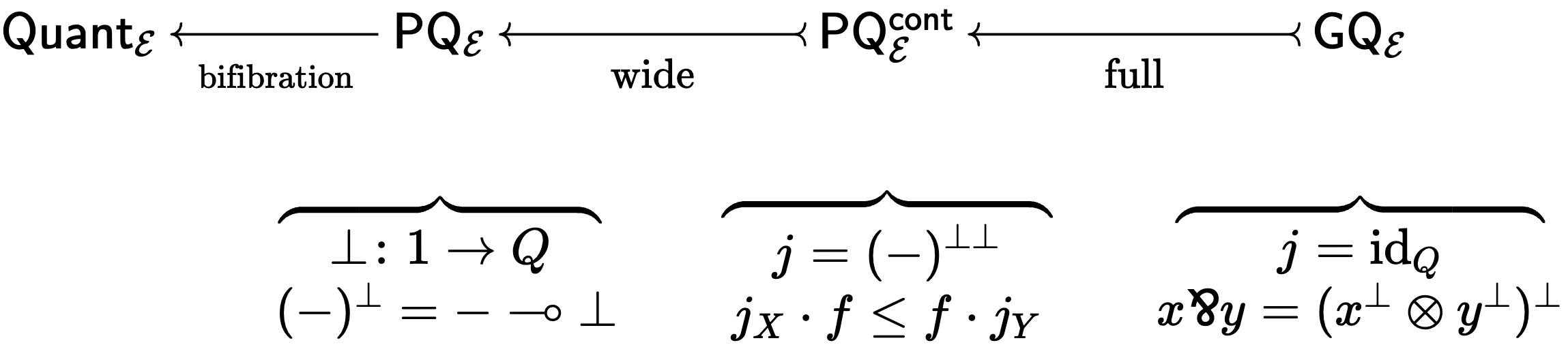
A sequence of forgetful functors:


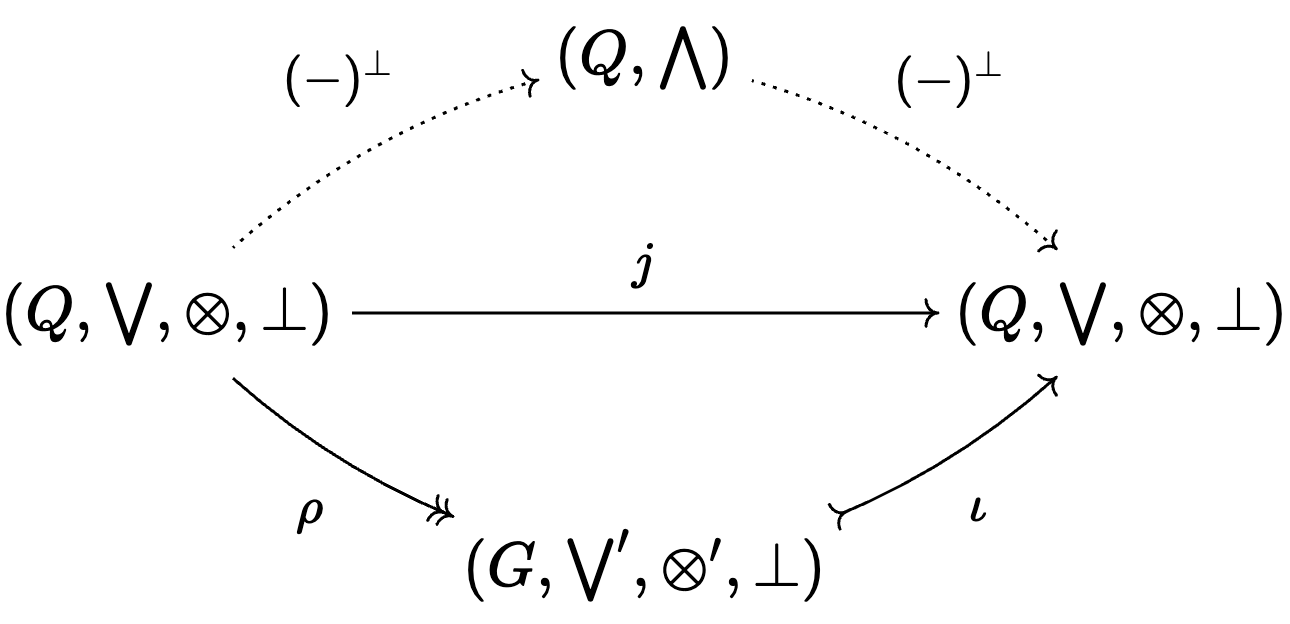
Girard quantales are a reflective subcategory

Extra: Pointed quantales and residuation

\begin{align*} (-)^*\in\ &\mathsf{Sup}_\mathcal{E}(\mathcal{Q},\mathcal{Q}^{\rm op}) :=& a\mapsto \bigvee\{b\ |\ a\otimes b\leq I\}\\ j(-) \in\ &\mathsf{Quant}_\mathcal{E}(Q,Q) := &(-)^{**} \end{align*}

The free sequent-set functor

F^\vdash \colon \mathcal{E}\to \mathsf{Quant}_\mathcal{E}


E.g. in \mathsf{Set}, it sends a set X to the set of assignments of X-sequents1 as good or bad.

F^\vdash a left adjoint

Extra: The free sequent-set functor … is a left adjoint

F^\vdash \colon \mathcal{E}\to \mathsf{Quant}_\mathcal{E}\qquad U^\vdash \colon \mathsf{Quant}_\mathcal{E}\to \mathcal{E}


The (co)unit might seem kind of messy at first…

\begin{align*} \eta^\vdash_X(x) &= \langle \{([x],0)\}, \{(0,[x])\} \rangle\\ \varepsilon^\vdash_X(S) &= \bigvee\big\{\textstyle\bigotimes_j a^+_j\otimes\bigotimes_k b^-_k \ \big|\ \langle\sum_j(a^+_j,a^-_j),\sum_k(b^+_k,b^-_k)\rangle\in S\big\} \end{align*}

Extra: The free sequent-set functor … is a left adjoint

F^\vdash \colon \mathcal{E}\to \mathsf{Quant}_\mathcal{E}\qquad U^\vdash \colon \mathsf{Quant}_\mathcal{E}\to \mathcal{E}


The (co)unit might seem kind of messy at first…

\begin{align*} \eta^\vdash_X(x) &= \langle \{([x],0)\}, \{(0,[x])\} \rangle\\ \varepsilon^\vdash_X(S) &= \bigvee\big\{\textstyle\bigotimes_j a^+_j\otimes\bigotimes_k b^-_k \ \big|\ \langle\sum_j(a^+_j,a^-_j),\sum_k(b^+_k,b^-_k)\rangle\in S\big\} \end{align*}

… but the oddness comes from the doubling self-adjunction:

\mathsf{CMon}(X^2,Y)\cong \mathsf{CMon}(X,Y)^2\cong \mathsf{CMon}(X,Y^2)

\begin{align*} \eta^{\rm Dbl}_X(&x) &=&\ \langle (x,0), (0,x) \rangle\\ \varepsilon^{\rm Dbl}_X(\langle (a,b)&,(c,d)\rangle) &=&\ a+d \end{align*}

Internal implication frames (1/4): definition


An object of \mathsf{IF}^{\rm cont}_\mathcal{E} is a pair (X,I)

  • An object X \in \operatorname{Ob}\mathcal{E}
  • A sequent sub-object I \rightarrowtail \mathbb{N}[X]^2\quad (i.e. 1\to F^\vdash X)

Internal implication frames (2/4): example frame in \mathsf{Set}

Some assumptions about a frame (X,I) to make it finitely representable:

X=\{a,b\}

Multiplicity doesn’t matter for whether or not a sequent is good or not.

\begin{array}{||c||c|c|c|c||} \hline\hline \mathcal{P}(X)^2 & 0 & a^- & b^- & a^-b^- \\ \hline\hline 0 & \vdash & \vdash a & \vdash b & \vdash a,b \\ \hline a^+ & a \vdash & a\vdash a & a \vdash b & a \vdash a,b \\ \hline b^+ & b\vdash & b \vdash a & b \vdash b & b \vdash a,b \\ \hline a^+b^+ & a,b\vdash & a,b\vdash b & \vdash & a,b\vdash a,b\\ \hline\hline \end{array}

\begin{array}{||c||c|c|c|c||} \hline\hline I & 0 & a^- & b^- & a^-b^- \\ \hline\hline 0 & \checkmark & \checkmark & \times & \checkmark \\ \hline a^+ & \times & \checkmark & \times & \checkmark \\ \hline b^+ & \times & \times & \checkmark & \checkmark \\ \hline a^+b^+ & \checkmark & \checkmark & \checkmark & \checkmark \\ \hline\hline \end{array}

E.g. in this frame:

a\vdash a

\quad \vdash a

b\nvdash a

Extra: Why represent radically substructural relations?

Logical consequence relations are a source of $ $ relations. Common assumptions:

  • monotonicity: weakening, portability of reasoning
  • transitivity1: (mixed) cut, composability of reasoning

Ordinary language monotonicity violation:

“I’ll strike a match, x\textcolor{red}\vdashx will light”    |||    “I’ll strike a match, x”, “x is wet” \nvdashx will light”


Ordinary language transitivity violation:

“bird(x)” \textcolor{red}{\vdash} “flies(x)”    |||   “penguin(x)”, “flies(x)” \vdash    |||   “bird(x)”, “penguin(x)” \nvdash


Transitivity violation from distinguishing explicit contradictions from implicit ones:

       C \wedge \neg C\vdash       |||      C \wedge \neg C\vdash A \wedge \neg A       |||      B\vdash A\wedge \neg A       |||       B \textcolor{red}\nvdash

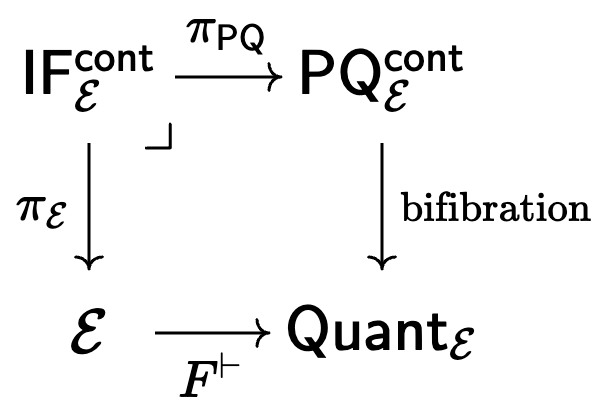
Internal implication frames (3/4): free pointed quantale

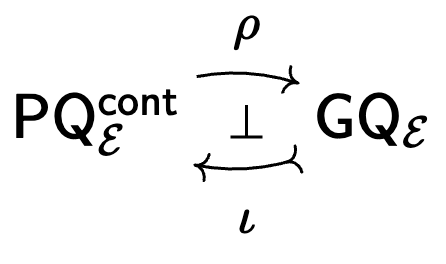
The pullback of a left adjoint along a fibration is itself a left adjoint, so \pi_{\mathsf{PQ}} is a left adjoint!

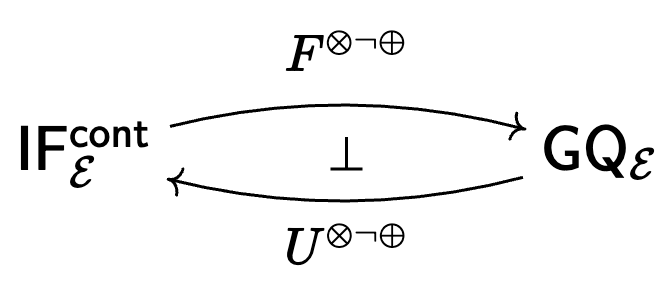
Internal implication frames (4/4): free Girard quantale


An object of \mathsf{IF}^{\rm cont}_\mathcal{E} is a pair (X,I)

  • An object X \in \operatorname{Ob}\mathcal{E}
  • A sequent sub-object I \rightarrowtail \mathbb{N}[X]^2\quad (i.e. 1\to F^\vdash X)

Compose free pointed quantale with \mathsf{GQ} reflective subcategory adjunction:

Semantic consequence relation

The unit is \eta_\mathcal{X}\colon \mathcal{X}\to \hat{\mathcal{X}} where \hat{\mathcal{X}}:=(\hat{X},\hat{I}) is the corresponding semantic frame.

\hat X = \{(A,B)\ |\ A,B \in F^\vdash X, A=A^{**}, B=B^{**}\}


Semantic values are pairs of sub-sequent objects (premisory role and conclusory role)

  • Only the former is relevant to consequence when the value is a premise
  • Only the latter is relevant to consequence when the value is a conclusion

Example semantic consequence between two arbitrary premises + conclusions

\langle a_+,a_-\rangle,\langle b_+,b_-\rangle \vDash \langle c_+,c_-\rangle,\langle d_+,d_-\rangle \iff a_+\otimes b_+\otimes c_-\otimes d_- \subseteq I

Semantic consequence relation: conservativity

The unit is \eta_\mathcal{X}\colon \mathcal{X}\to \hat{\mathcal{X}} where \hat{\mathcal{X}}:=(\hat{X},\hat{I}) is the corresponding semantic frame.

\hat X = \{(A,B)\ |\ A,B \in F^\vdash X, A=A^{**}, B=B^{**}\}


The unit is a \mathcal{E} morphism, thought of as assigning semantic values.

Property of conservativity

\Gamma \vdash \Delta \iff [\![ \Gamma ]\!]\vDash [\![ \Delta ]\!]

Defining operations on the semantic space

For any semantic frame (\hat X, \hat I) we can intelligibly apply the following operations:

Formula Interpretation Formula Interpretation
[\![ \neg A ]\!] \langle \texttt{a}_-,\texttt{a}_+\rangle [\![ A\wedge B ]\!] \left\langle \begin{matrix} \texttt{a}_+ \otimes \texttt{b}_+, \\ \texttt{a}_-\wedge \texttt{b}_- \wedge (\texttt{a}_-\otimes \texttt{b}_-) \end{matrix} \right\rangle
[\![ A\otimes B ]\!] \langle \texttt{a}_+\otimes \texttt{b}_+,\texttt{a}_+\mathop{\mathrm{\raisebox{-0.2ex}{⅋}}}\texttt{b}_+\rangle [\![ A\oplus B ]\!] \langle \texttt{a}_+ \vee \texttt{b}_+,\, \texttt{a}_- \wedge \texttt{b}_- \rangle

We obtain other operations by DeMorgan duals:

  • classical disjunction \quad \quad [\![ A\vee B ]\!]=[\![ \neg (\neg A \wedge \neg B) ]\!]
  • multiplicative disjunction \ [\![ A\mathop{\mathrm{\raisebox{-0.2ex}{⅋}}}B ]\!]=[\![ \neg (\neg A \otimes \neg B) ]\!]
  • additive conjunction \quad \quad [\![ A\& B ]\!]=[\![ \neg (\neg A \oplus \neg B) ]\!]

Special kinds of implication frames

The semantic space is often rich enough to interpret flavors of propositional logic.

Reflexive implication frames

  • contain all sequents x \vdash x
  • Semantic consequence is supralinear
Formula Interpretation
[\![ A\otimes B ]\!] \langle \texttt{a}_+\otimes \texttt{b}_+,\texttt{a}_+\mathop{\mathrm{\raisebox{-0.2ex}{⅋}}}\texttt{b}_+\rangle
[\![ A\oplus B ]\!] \langle \texttt{a}_+\vee \texttt{b}_+,\texttt{a}_+\wedge \texttt{b}_+\rangle

Indefeasibly-reflexive + contractive frames

  • contain all sequents \Gamma, x \vdash x, \Delta
  • \Gamma, x \vdash \Delta\iff \Gamma,x,x\vdash \Delta
  • Semantic consequence is supraclassical
Formula Interpretation
[\![ A\wedge B ]\!] \left\langle \begin{matrix} \texttt{a}_+ \otimes \texttt{b}_+, \\ \texttt{a}_-\wedge \texttt{b}_- \wedge (\texttt{a}_-\otimes \texttt{b}_-) \end{matrix} \right\rangle

Note: these supra-linear/classical frames need not satisfy monotonicity or even transitivity!

Takeaway: look at the structure of your domain you’re trying to elucidate with semantic analysis. Depending on its features, some logics may be fit/unfit for purpose.

Extra: Supralinearity

Prop: These clauses validate the logical rules of \rm MALL

\boxed{ \begin{array}{c} \Gamma \vdash A, \Delta\\ \hline\hline \Gamma,\neg A \vdash \Delta \end{array} }

\begin{align*} &&\pi_2(\langle \texttt{a}_+,\texttt{a}_-\rangle) &\subseteq (\Gamma_+\Delta_-)^* \\ {\scriptscriptstyle \iff\hspace{-3mm}}&& \texttt{a}_- &\subseteq (\Gamma_+\Delta_-)^* \\ {\scriptscriptstyle \iff\hspace{-3mm}}&& \pi_1(\langle \texttt{a}_-,\texttt{a}_+\rangle) &\subseteq (\Gamma_+\Delta_-)^* \\ \end{align*}

\boxed{ \begin{array}{c} \Gamma, A\vdash \Delta\\ \hline \hline \Gamma \vdash \neg A,\Delta \end{array} }

\begin{align*} &&\pi_1(\langle \texttt{a}_+,\texttt{a}_-\rangle) &\subseteq (\Gamma_+\Delta_-)^* \\ {\scriptscriptstyle \iff\hspace{-3mm}}&& \texttt{a}_+ &\subseteq (\Gamma_+\Delta_-)^* \\ {\scriptscriptstyle \iff\hspace{-3mm}}&& \pi_2(\langle \texttt{a}_-,\texttt{a}_+\rangle) &\subseteq (\Gamma_+\Delta_-)^* \\ \end{align*}

\boxed{ \begin{array}{c} \Gamma,A,B \vdash \Delta \\ \hline\hline \Gamma, A \otimes B\vdash \Delta \end{array} }

\begin{align*} \texttt{a}_+ \texttt{b}_+ &\subseteq \Gamma_+\Delta_-^\bot \\ \text{ (Holds }&\text{by defn)}\\ \end{align*}

\boxed{ \begin{array}{c} \Gamma \vdash A,\Delta \quad \Theta \vdash B,\Omega \\ \hline \Gamma, \Theta \vdash A \otimes B, \Delta,\Omega \end{array} }

\begin{align*} (\Gamma_+\Delta_-\subseteq \texttt{a}_-^\bot) &\wedge (\Theta_+\Omega_- \subseteq \texttt{b}_-^\bot) \\ {\scriptscriptstyle \implies} \Gamma_+\Delta_- \Theta_+&\Omega_- \subseteq \texttt{a}_-^\bot \texttt{b}_-^\bot\\ {\scriptscriptstyle \iff} \Gamma_+\Delta_- \Theta_+&\Omega_- \subseteq (\texttt{a}_- \mathop{\mathrm{\raisebox{-0.2ex}{⅋}}}\texttt{b}_- )^\bot\\ \end{align*}

\boxed{ \begin{array}{c} \Gamma, A \vdash \Delta \quad \Gamma, B \vdash \Delta\\ \hline\hline \Gamma, A \oplus B \vdash \Delta \end{array} }

\begin{align*} (\Gamma_+\Delta_- \subseteq a_+^\bot)&\wedge (\Gamma_+\Delta_- \subseteq \texttt{b}_+^\bot) \\ {\scriptscriptstyle \iff} \Gamma_+\Delta_- &\subseteq \texttt{a}_+^\bot \wedge \texttt{b}_+^\bot \\ {\scriptscriptstyle \iff} \Gamma_+\Delta_- &\subseteq (\texttt{a}_+ \vee \texttt{b}_+)^\bot \\ \end{align*}

\boxed{ \begin{array}{c} \Gamma \vdash A,\Delta\\ \hline \Gamma \vdash A \oplus B,\Delta \end{array} }

\begin{align*} \Gamma_+\Delta_- &\subseteq \texttt{a}_-^\bot \\ {\scriptscriptstyle \implies} \Gamma_+\Delta_- &\subseteq \texttt{a}_-^\bot \vee \texttt{b}_-^\bot \\ {\scriptscriptstyle \iff} \Gamma_+\Delta_- &\subseteq (\texttt{a}_- \wedge \texttt{b}_-)^\bot \\ \end{align*}

Prop: the consequence relation \vDash from \eta_\pm is supralinear.

Suppose \Gamma \vdash_{\rm MALL}\Delta. By cut-elimination for MALL, \Gamma \vdash_{\rm MALL}\Delta has a cut-free proof. The base case is that the proof is a single identity rule, which holds in \mathcal{X}' in virtue of being a reflexive implication frame. Each remaining step in the proof is a logical rule of MALL, which holds in \mathcal{X}'. Therefore \Gamma \vDash \Delta. That the valid atomic sequents are precisely \bot is a restatement that \eta_\pm is conservative.

Extra: Idempotent Example (1/3)


Let \mathcal{X}:=(X,I) where X=\{a,b\} and I is given by the following table.

E.g. a\vdash a,b and a\nvdash b for this frame.

\begin{array}{||c||c|c|c|c||} \hline\hline I & 0 & a^- & b^- & a^-b^- \\ \hline\hline 0 & \checkmark & \checkmark & \times & \checkmark \\ \hline a^+ & \times & \checkmark & \times & \checkmark \\ \hline b^+ & \times & \times & \checkmark & \checkmark \\ \hline a^+b^+ & \checkmark & \checkmark & \checkmark & \checkmark \\ \hline\hline \end{array}

Here is an individual (-)^* computation

\begin{array}{||c||c|c|c|c||} \hline\hline \{a^+\}* & 0 & a^- & b^- & a^-b^- \\ \hline\hline 0 & \times & \checkmark & \times & \checkmark \\ \hline a^+ & \times & \checkmark & \times & \checkmark \\ \hline b^+ & \checkmark & \checkmark & \checkmark & \checkmark \\ \hline a^+b^+ & \checkmark & \checkmark & \checkmark & \checkmark \\ \hline\hline \end{array}

Here are all of the singletons (\{-\})^*:

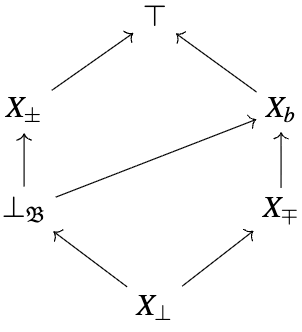
\begin{array}{||c||c|c|c|c||} \hline\hline (\{-\})^* & 0 & a^- & b^- & a^-b^- \\ \hline\hline 0 & I & X_b & X_\pm & \top \\ \hline a^+ & X_\pm & \top & X_\pm & \top \\ \hline b^+ & X_\mp & X_\mp & \top & \top \\ \hline a^+b^+ & \top & \top & \top & \top \\ \hline\hline \end{array}

X_\pm:=\top\setminus\mathcal{P}[\{a^+,b^-\}] \qquad X_b:=\top \setminus \{b^+,b^+a^-\} X_\mp :=\top\setminus\mathcal{P}[\{a^-,b^+\}] \qquad \top:=\mathcal{P}[X+X]

Extra: Idempotent Example (2/3)

Now we can derive more inferential roles in \mathfrak{G} by taking intersections of the singleton roles from the previous table, but this just yields one new role X_\bot=\{a^+,b^+\}^\bot = X_\pm\cap X_\mp.


\begin{array}{||c||c|c|c|c||} \hline\hline (-)^{**} & 0 & a^- & b^- & a^-b^- \\ \hline\hline 0 & X_b & I & X_\mp & X_\bot \\ \hline a^+ & X_\mp & I & X_\mp & X_\bot \\ \hline b^+ & X_\pm & X_\pm & X_\bot & X_\bot \\ \hline a^+b^+ & X_\bot & X_\bot & X_\bot & X_\bot \\ \hline\hline \end{array}

\begin{array}{||c||c|c|c|c|c|c||} \hline\hline \vee & X_b & X_\bot & I & X_\pm & X_\mp & \top \\ \hline\hline X_b & X_b & X_b & X_b & \top & X_b & \top \\ \hline % 1 X_\bot & X_b & X_\bot & I & X_\pm & X_\mp & \top \\ \hline % 2 I & X_b & I & I & X_\pm & X_b & \top \\ \hline % 3 X_\pm & \top & X_\pm & X_\pm & X_\pm & \top & \top \\ \hline % 4 X_\mp & X_b & X_\mp & X_b & \top & X_\mp & \top \\ \hline % 5 \top & \top & \top & \top & \top & \top & \top \\ \hline\hline % 6 \end{array}

\begin{array}{||c||c|c|c|c|c|c||} \hline\hline \otimes & X_b & X_\bot & I & X_\pm & X_\mp & \top \\ \hline\hline X_b & X_b & X_\bot & I & X_\pm & X_\mp & \top \\ \hline % 1 X_\bot & X_\bot & X_\bot & X_\bot & X_\bot & X_\bot & X_\bot \\ \hline % 2 I & I & X_\bot & I & X_\pm & X_\bot & X_\pm \\ \hline % 3 X_\pm & X_\pm & X_\bot & X_\pm & X_\pm & X_\bot & X_\pm \\ \hline % 4 X_\mp & X_\mp & X_\bot & X_\bot & X_\bot & X_\mp & X_\mp \\ \hline % 5 \top & \top & X_\bot & X_\pm & X_\pm & X_\mp & \top \\ \hline\hline % 6 \end{array}

Extra: Idempotent Example (3/3)

We have base cases:

[\![ a ]\!]=\langle \{a^+\}^{**},\{a^-\}^{**} \rangle=\langle X_\mp,I \rangle \qquad [\![ b ]\!]=\langle \{b^+\}^{**},\{b^-\}^{**} \rangle=\langle X_\pm,X_\mp \rangle

We can use the formula for semantic consequence to show that: {[\![ a ]\!],[\![ b ]\!]\vDash [\![ a\wedge b ]\!]}

\begin{align*} \pi_1([\![ a ]\!]) \otimes \pi_1([\![ b ]\!]) \otimes \pi_2([\![ a \wedge b ]\!]) &\subseteq I \\ \pi_1([\![ a ]\!]) \otimes \pi_1([\![ b ]\!]) \otimes \pi_2([\![ a ]\!]) \vee \pi_2([\![ b ]\!]) \vee (\pi_2([\![ a ]\!]) \otimes \pi_2([\![ b ]\!])) &\subseteq I \\ X_\mp \otimes X_\pm \otimes (I\vee X_\mp \vee (I\otimes X_\mp)) &\subseteq I \\ X_\mp \otimes X_\pm \otimes X_b &\subseteq I \\ X_\bot &\subseteq I \\ \end{align*}

\mathcal{X} is indefeasibly reflective+contractive, so \vDash is supraclassical (but not monotonic).

Extra: Full NMMS calculus

\begin{array}{c} \Gamma \vdash A, \Delta \\ \hline\hline \Gamma, \neg A \vdash \Delta \\ \end{array}
\begin{array}{c} \Gamma, A \vdash \Delta \\ \hline\hline \Gamma \vdash \neg A, \Delta \\ \end{array}
\begin{array}{c} \Gamma, A,B \vdash \Delta \\ \hline\hline \Gamma, A\wedge B \vdash \Delta \\ \end{array}
\begin{array}{c} \Gamma\vdash A,B,\Delta \\ \hline\hline \Gamma \vdash A\vee B, \Delta \\ \end{array}
\begin{array}{c} \Gamma,A\vdash \Delta\ \ \Gamma,B\vdash \Delta\ \ \Gamma,A,B\vdash \Delta \\ \hline\hline \Gamma, A\vee B, \vdash \Delta \\ \end{array}

Computer implementation

These calculations can be hairy but can be mechanized: ROLE.jl

"""
a = 'Zazzles the cat has four legs', 
b = 'Zazzles the cat lost a leg'

|     |   | a | b | a,b |
|-----|---|---|---|-----|
|     | ✓ | ✓ | × |   ✓ |
|   a | × | ✓ | × |   ✓ |
|   b | × | × | ✓ |   ✓ |
| a,b | ✓ | ✓ | ✓ |   ✓ |
"""
C = ImpFrame([[]=>[:a], []=>[:a,:b], [:a,:b]=>[]], [:a,:b]; containment=true)
𝕒, 𝕓 = contents(C)
= typeof(𝕒)[]               # empty list of contents
@test (((𝕒  𝕓)  𝕒)  𝕒) # pierce's law
@test ((𝕒  𝕓)  𝕒)       # not pierce's law

Especially when considering contractive frames (finite set of candidate implications).

Technical Outline

1. Internal (pointed, Girard) quantales

 (Hidden: deriving reflector of Girard quantale reflective subcategory)

2. The ‘free sequent-set’ functor

 (Hidden: unit and counit formulas)

3. Implication frames and the logical completion

 (Hidden: why model radically-substructural reason relations?)

4. Interpreting MALL and classical logic in a frame

 (Hidden: Supralinearity proof)

 (Hidden: Nonmonotonic Multisuccedent Sequent calculus)

  1. Nominal sets to model subsentential structure

The category of nominal sets

Two ways of looking at \mathsf{Nom} the category of nominal sets:

Nominal sets as actions

Let \mathbb{A}=\{a,b,c,...\} be a countably infinite set.

A nominal set is a finitely-supported \rm Perm\ \mathbb{A} action.

  • Each element x \in X has a finite support, the variables it depends on.
  • If the support is fixed by some permutation \pi, then \pi’s action fixes x


Nominal sets as copresheaves

Let \mathbb{I} be the category of finite sets and injective maps.

A nominal set is a pullback-preserving functor \mathbb{I}\to\mathsf{Set}.

\Delta \mapsto \{\text{subset of $X$ which is supported by $\Delta$}\}

Extra: Elements of nominal sets

Let X \in \mathsf{Nom} and Q_{ab} \in X be an element with support \{a,b\}.

  • this is not necessarily the same thing as a syntax term application Q(a,b)
    • \sigma_{ab}\bullet Q_{ab} \ \ \ \ \ \ = Q_{ba}\ \ \ \ \ \overset{?}{=}Q_{ab} (in general, may or may not be equal)
    • \sigma_{ab}\bullet Q(a,b)= Q(b,a)\ne Q(a,b) (terms are free nominal set elements)1

This is more and less expressive than standard predicate logic syntax:

  • Can represent unordered predicates
  • Cannot represent Q(a,a) — this might as well be an element Q'(a) with support \{a\}
  • Substitution only defined for free variables (or permutations)

What is an implication frame internal to \mathsf{Nom}

It is a nominal set X equipped with a sub-nominal I\rightarrowtail \mathbb{N}[X]^2.

  • “Claimables” are now allowed to depend on parameters: e.g. \psi, P_a,P_b,Q_{ab}

  • Sequent components can share variables: e.g. P_a \vdash Q_{ab} and Q_{ba},P_a \nvdash Q_{ab}


I still picks out the subset of good sequents, but the choice must be equivariant:

  • label names cannot matter: P_a \vdash Q_{ab} \iff P_b \vdash Q_{ba} \iff P_a \vdash Q_{ac}

  • notation to help with this: P_- \vdash Q_{-=}

What is the free Girard quantale in \mathsf{Nom}

Definition: finitely-supported subset of a nominal set

A subset of nominal set is supported by \Gamma if it is unchanged by permutations that fix \Gamma, applied pointwise to the elements of the subset.

  • Any nominal subset supported by \varnothing because it’s equivariant.
  • The subset \{P_a,P_b\} is not equivariant but it is finitely supported by \{a,b\}.
  • The infinite subset \{P_a,P_c,P_d,...\} is not finitely supported.

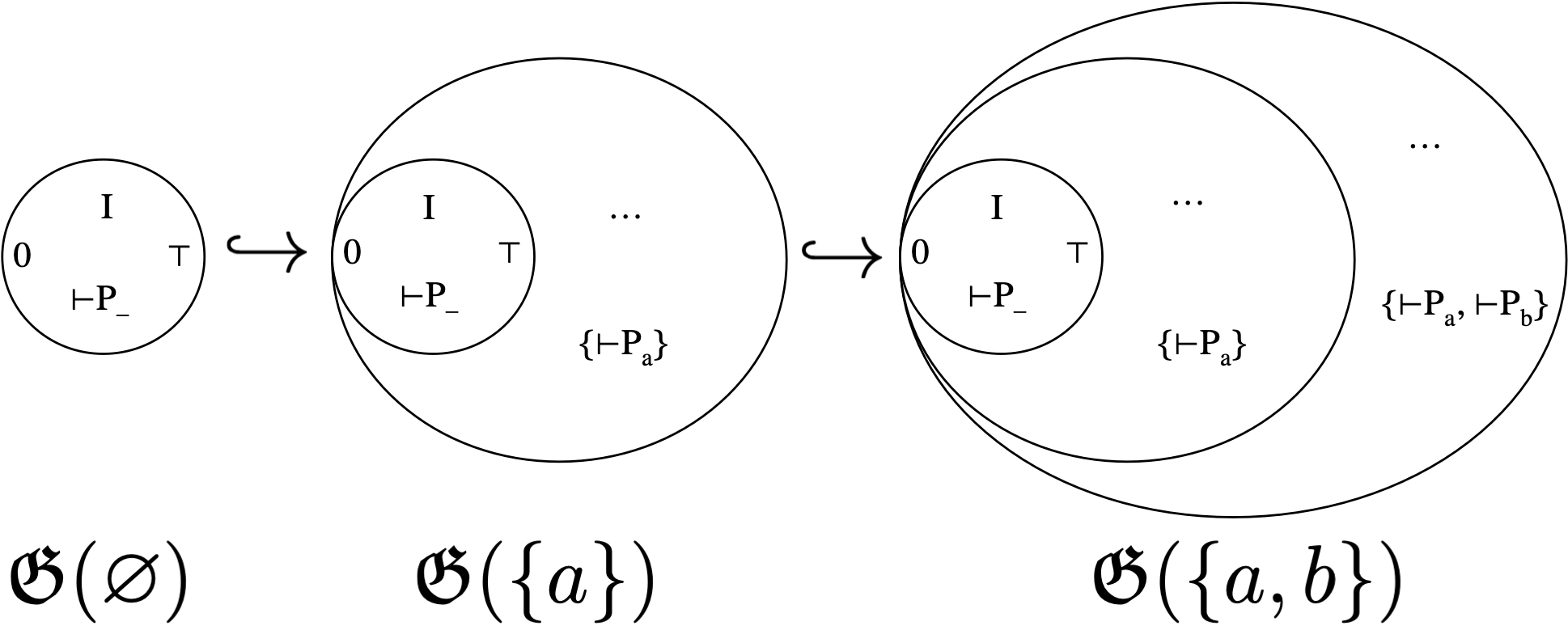
Let \mathfrak{G} be the free internal Girard quantale for (X,I) \in \mathsf{IF}_{\mathsf{Nom}}.

  • These are the (-)^{**}-closed f.s. subsets of \mathbb{N}[X]^2.

We need more than just Girard structure on \mathfrak{G} in order to define [\![ \forall a\colon \Phi(\Gamma,a) ]\!] on \mathfrak{G}^2 elements.

MALL Hyperdoctrine

If we view \mathfrak{G} from the indexed perspective, we have a functor \mathfrak{G}\colon \mathbb{I}\to \mathsf{GQ}.


This is the data of a MALL hyperdoctrine if some other properties obtain:

  • Left/right adjoints for each \Gamma \rightarrowtail \Delta
  • Frobenius reciprocity
  • Beck-Chevalley

MALL Hyperdoctrine: adjoints

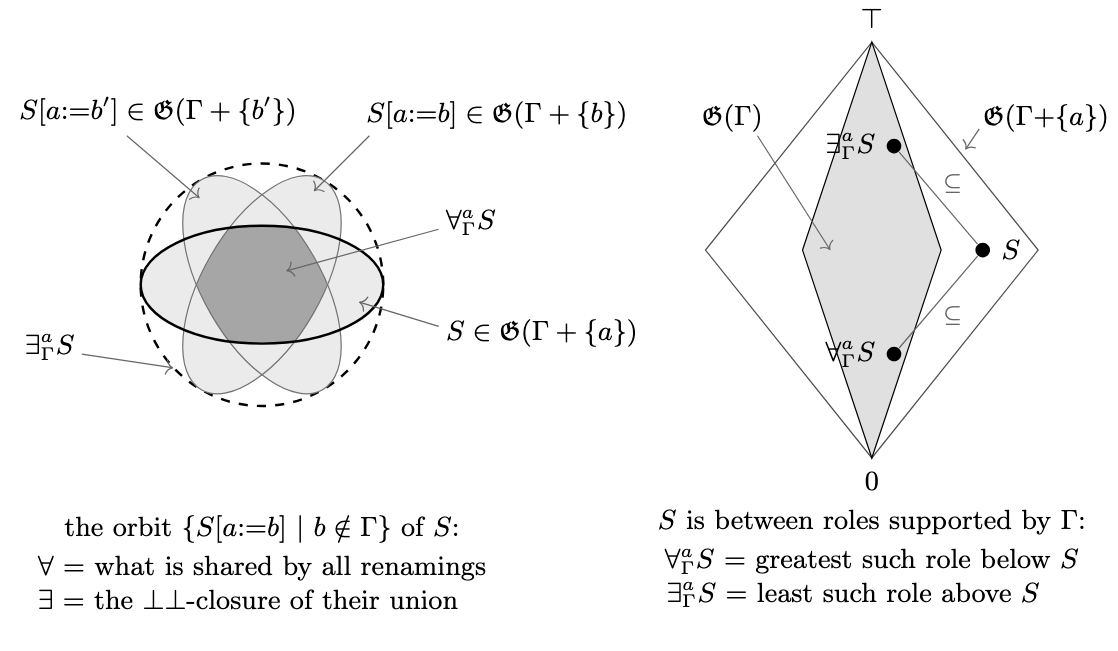
Let S \in \mathfrak{G}(\Gamma+\{a\}) and let \iota\colon \Gamma\hookrightarrow\Gamma+\{a\}.

Formula for right adjoint to inclusion of Girard quantales: \forall^{a}_\Gamma(S)=\bigcap_{b \notin \Gamma} S[a:=b]

Extra: MALL Hyperdoctrine: adjoints

Let S \in \mathfrak{G}(\Gamma+\Delta) with \iota\colon \Gamma\hookrightarrow\Delta.

\forall^\Delta_\Gamma(S)=\bigcap_{b \notin \Gamma} S[a:=b] \qquad \text{ and } \qquad \exists^\Delta_\Gamma(S) =(\bigcup_{b \notin \Gamma} S[a:=b])^{\bot\bot}

\mathfrak{G}(\iota) \dashv \forall^\Delta_\Gamma      i.e.      y \leq_{\mathfrak{G}(\Gamma)} \forall^\Delta_\Gamma S \iff \mathfrak{G}(\iota)(y) \leq_{\mathfrak{G}(\Gamma+\Delta)} S

\small \begin{align*} y &\leq_\Gamma \forall^\Delta_\Gamma(S) && \\ &\iff y \leq \textstyle\bigcap_{\pi \in G_\Gamma} \pi S && \text{definition}\\ &\iff \forall \pi:\ y \leq \pi S && \text{universal property of }\textstyle\bigcap\\ &\iff \forall \pi:\ \pi^{-1}y \leq S && \phi_{\pi^{-1}}\text{ order-auto.},\ \phi_{\pi^{-1}}(\pi S)=S\\ &\iff \forall \pi:\ y \leq S && y\in \mathfrak{G}(\Gamma),\ \text{so }\pi^{-1}y = y\\ &\iff y \leq S && \text{independent of }\pi,\ \operatorname{id}\in G_\Gamma\\ &\iff \mathfrak{G}_\mathcal{Q}(\iota)(y) \leq_{\Gamma+\Delta} S && \text{weakening is the inclusion} \end{align*}

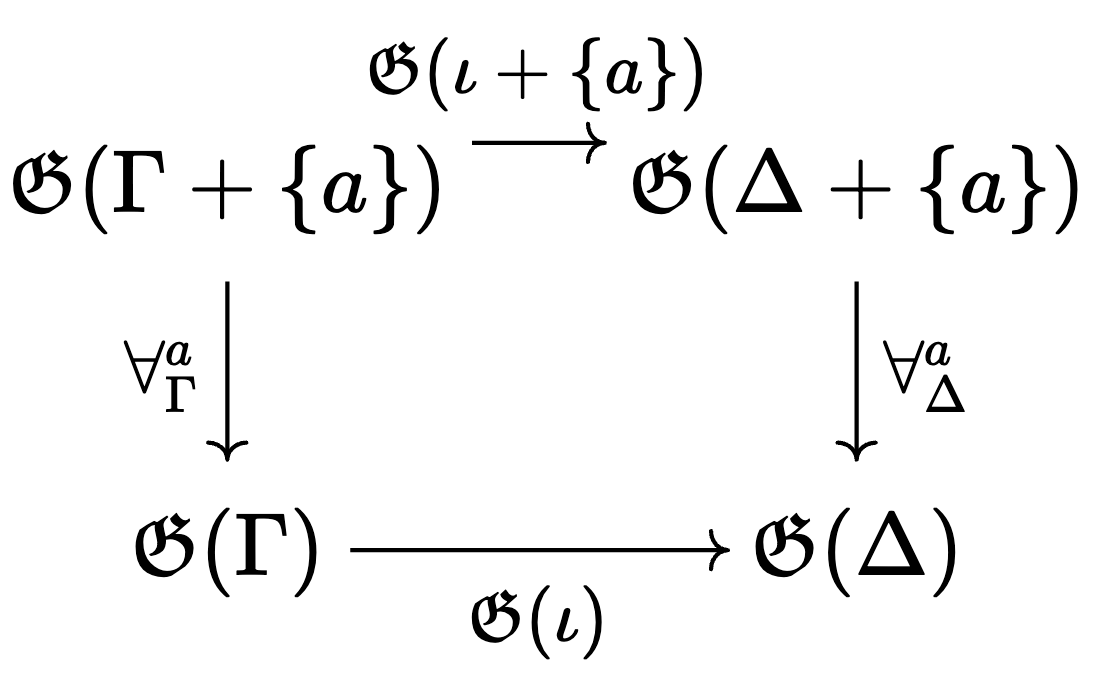
MALL Hyperdoctrine: Beck-Chevalley


Let \iota\colon \Gamma\rightarrowtail \Delta and S \in \mathfrak{G}(\Gamma+\{a\}).

The Beck-Chevalley condition1 is to the right:

This property holds if the subobject I in (X,I\rightarrowtail \mathbb{N}[X]^2) is substitution-equivariant.

Substitution-equivariance (1/2)

Substitution equivariance of a monoid subobject in \mathsf{Nom}

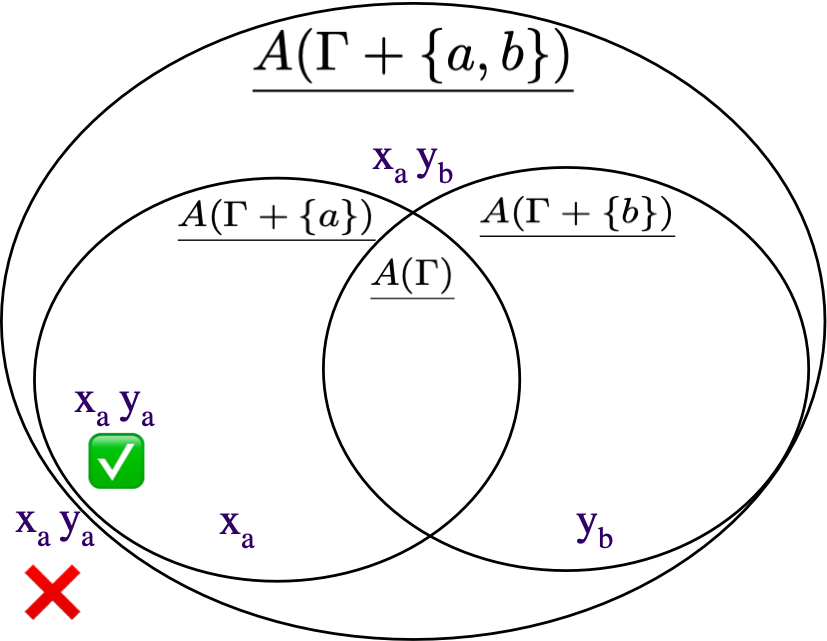
A \rightarrowtail M, is substitution-equivariant iff closed under identifying names in the following sense. Suppose \{a,b\}\subseteq \Gamma with let x_a \in M(\Gamma\setminus\{b\}) and y_b \in M(\Gamma\setminus\{a\}) and x_ay_b \in A(\Gamma). Substitution-equivariance means that x_ay_a \in A(\Gamma\setminus\{b\}), where y_a:=y_b[b{:=}a].

Extra: Substitution-equivariance (1.5/2)

Substitution equivariance of a monoid subobject in \mathsf{Nom}

A \rightarrowtail M, is substitution-equivariant iff closed under identifying names in the following sense. Suppose \{a,b\}\subseteq \Gamma with let x_a \in M(\Gamma\setminus\{b\}) and y_b \in M(\Gamma\setminus\{a\}) and x_ay_b \in A(\Gamma). Substitution-equivariance means that x_ay_a \in A(\Gamma\setminus\{b\}), where y_a:=y_b[b{:=}a].


Substitution equivariance example and nonexample

Consider \mathbb{A} as a nominal set. Then \mathbb{N}[\mathbb{A}] is the nominal set of multisets of names.

  • Let A \rightarrowtail \mathbb{N}[\mathbb{A}] pick out all multisets which mention some a\in\mathbb{A} at least twice.

         ✅: \{c^2,a,b\}=\{c,a\}+\{c,b\} \in A(\{a,b,c\}) and \{c,a\}+\{c,a\} \in A(\{a,c\})

  • Let B \rightarrowtail \mathbb{N}[\mathbb{A}] be the complement of A.

        ❌: \{a,b\} = \{a\} + \{b\} \in B(\{a,b\}) and \{a\}+\{a\} \notin A(\{a\}).

Substitution-equivariance (2/2)

Substitution equivariance of a monoid subobject in \mathsf{Nom}

A \rightarrowtail M, is substitution-equivariant iff closed under identifying names in the following sense. Suppose \{a,b\}\subseteq \Gamma with let x_a \in M(\Gamma\setminus\{b\}) and y_b \in M(\Gamma\setminus\{a\}) and x_ay_b \in A(\Gamma). Substitution-equivariance means that x_ay_a \in A(\Gamma\setminus\{b\}), where y_a:=y_b[b{:=}a].


Substitution equivariance nonexample in implication frames

Consider Roberts Rules of Order, which states a motion must be seconded for the motion to be considered. We encode this norm in an implication frame.

{\rm Motion}(a,m),{\rm Second}(b,m)\vdash {\rm Considered}(m)

This is an element of I. But we do not want the following in I, which is required by sub. equivariance:

{\rm Motion}(a,m),{\rm Second}(a,m)\vdash {\rm Considered}(m)

Therefore we should allow the possibility of frames which are not substitutionally-equivariant.

Interpretations of quantifiers1

For the semantic clause, let [\![ \phi(\Gamma;a) ]\!] have \texttt{p} as a premisory role and \texttt{c} as a conclusory role.

[\![ \forall a\colon \phi(\Gamma;a) ]\!]:=\langle \forall^a_\Gamma(\texttt{p}),\ \exists^a_\Gamma(\texttt{c}) \rangle \quad \equiv\quad [\![ \mathop{\&}\limits_{b \notin \Gamma} \phi(\Gamma;a)[a:=b] ]\!]

Now we can logically say what it means for a candidate implication to be in I:

a_1,...,a_n\vdash_\Gamma b_1,...,b_m \quad \iff\quad \vDash \forall \Gamma\colon (a_1 \otimes ... \otimes a_n)\multimap (b_1 \mathop{\mathrm{\raisebox{-0.2ex}{⅋}}}... \mathop{\mathrm{\raisebox{-0.2ex}{⅋}}}b_m)

The following rules depend on Beck Chevalley:

Next steps

How to handle substitution more broadly?


How to draw more connections to existing techniques in categorical logic.


Computational implementation: substructural knowledge bases

  • Work with finite presentations of implication frames
  • Use the implicit logical structure to build / query them
  • Use the category of them to collaboratively / compositionally manipulate them

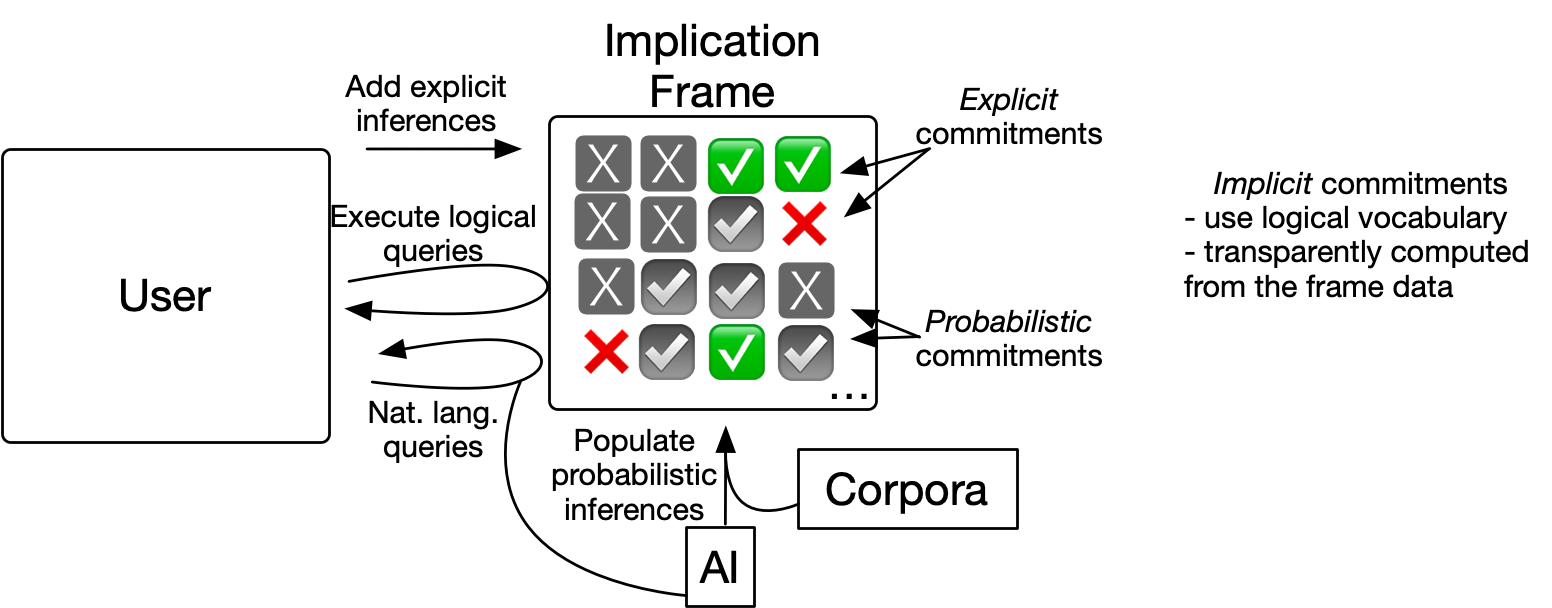
A vision for neurosymbolic AI

We want AI systems to have some kind of intelligible, interrogatable model.

At the same time, the lack of imposing structure (radical flexibility of present AI architectures) is practically useful.

Compromise: imp. frames have the right balance of unstructuredness and (latent) structure.

Extra: Future work

Def: Ordered implication frame

An ordered implication frame is a preorder (X,\leq) equipped with a monotone map \mathbb{N}[X^{\rm op}+X]\to 2

The order codifies a kind of substitutional license: A \leq B means that conclusions can be weakened A \mapsto B and premises can be weakened B \mapsto A.

Def: Enriched implication frame

An enriched implication frame is a \mathcal{V}-category \mathcal{A} equipped with a \mathcal{V}-presheaf in \widehat{S[\mathcal{A}^{\rm op}+\mathcal{A}]}, where S(-) denotes the free symmetric monoidal \mathcal{V}-category.

It’s not clear what \mathcal{V}-enrichment leads to:

  • In \mathsf{Set}-enriched setting, a frame a set of substitutions between any two claimables.

  • There is also a set of reasons why \Gamma \vdash \Delta.

Conclusions: logical expressivism

We can model a norm where some claimables can be asserted and denied, and some combinations of assertions and denials are in-bounds or not.

  • This is the data of a radically-substructural consequence relation.
  • This is a model of the thing that we care about when we do formal modeling, including the assignment of informal concepts to formal constructs:
    • when we design formal calculi, a criterion of adequacy is that they reproduce inferences we already take ourselves to be entitled to make!

Even if we assume nothing else about the domain, we can introduce new claimables to be asserted or denied, built out of connectives of the old ones.

  • This does not change the goodness of inference between the original claimables (conservative extension).

  • When the norm meets some basic criteria, these connectives recover the inferential properties we expect from well known logics (MALL, classical logic).

By generalizing predicate logic, we can compactly represent an infinitude of judgments into a single sequent.

Thank you for listening

And even more thanks to:

      Kevin Carlson

      David Jaz Myers

      Evan Patterson

      Lucy Horowitz

And the Research on Logical Expressivism (ROLE) group:

  • Robert Brandom, Ulf Hlobil, Ryan Simonelli, Rea Golan, Shuhei Shimamura, and others.

References

Fodor, Jerry A, and Ernest Lepore. 1993. “Why Meaning (Probably) Isn’t Conceptual Role.” Philosophical Issues 3: 15–35.
Gabbay, Murdoch J, and Martin Hofmann. 2008. “Nominal Renaming Sets.” International Conference on Logic for Programming Artificial Intelligence and Reasoning, 158–73.
Girard, Jean-Yves. 1995. “Linear Logic: Its Syntax and Semantics.” Proceedings of the Workshop on Advances in Linear Logic, 1–42.
Hlobil, Ulf, and Robert B Brandom. 2025. Reasons for Logic, Logic for Reasons: Pragmatics, Semantics, and Conceptual Roles. Routledge.
Restall, Greg. 2005. “Multiple Conclusions.” Logic, Methodology and Philosophy of Science: Proceedings of the Twelfth International Congress, 189–205.