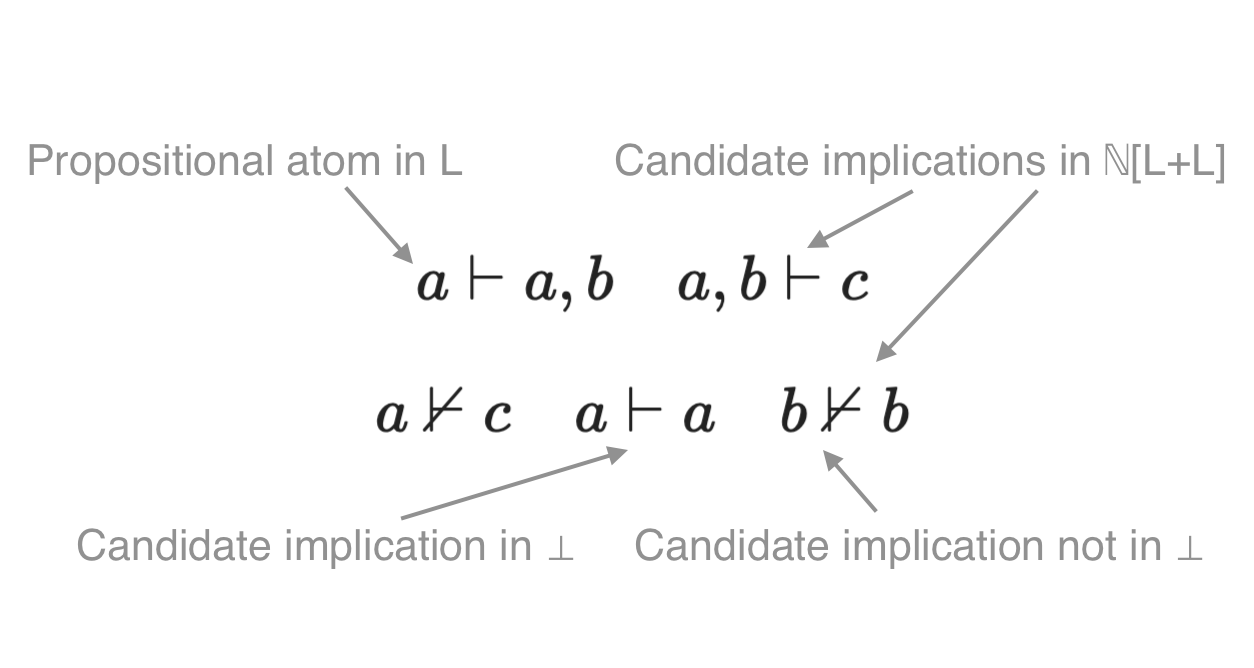
E.g. a\vdash a and \quad \vdash a and b\nvdash a in this frame.
Isn’t it just probabilistic inference?
Radically-substructural frames have a very rich algebraic structure.
Going for probability is just projecting away all of this rich structure onto the real line.
One can reconstruct a lot of the algebraic structure one started with, remarkably.
But why do that? You should only if you have to.
Rational choice (game- or decision-theoretic): relation between outcomes and options.
We reconstruct a notion of rationality in terms of maximizing expected utility
You can do that if you already have semantically-determined outcomes and options
You’ve presupposed the semantic content of those things, therefore your consequence relation is not trying to do the same thing as the one the logical expressivists are interested in
It is derivative/parasitic of a more basic notion of reason relation.
Hyperintentionality can’t be reconstructed via probability theory (Kit Fine)
Logical consequence relations
Logical consequence relations are a source of \ \vdash\ relations. Common assumptions:
monotonicity: weakening, portability of reasoning
transitivity1: (mixed) cut, composability of reasoning
Conceptions of consequence that admit radical substructurality:
There is a lattice of possible world states, and a notion of some being impossible. Worldly propositions denote parts of the world that make them true vs make them false. This induces a frame.
“\color{red}{\Delta} follows from \color{blue}\Gamma” = “Any fusion of verifiers of \color{blue}\Gamma and falsifiers of \color{red}\Delta is an impossible state.”
There is a set of things one can claim, two possible speech acts per claim, and a notion of some move combinations being incompatible. This is (directly) the data of an implication frame.
“\color{red}{\Delta} follows from \color{blue}\Gamma” = “It is out-of-bounds / incompatible to assert everything in \color{blue}\Gamma while denying everything in \color{red}\Delta”
Logical Elaboration + NMMS calculus
Logical expressivism
Logic ought express features of some antecedent, prelogical system of implications. Express means to make explicit (internalize) features of \bot that, were originally only describable in a metavocabulary.
The logical elaboration of a frame freely extends its atoms with connectives.
\begin{array}{c}
\Gamma \vdash A, \Delta \\
\hline\hline
\Gamma, \neg A \vdash \Delta \\
\end{array}
Let \widehat{f}:=\mathcal{P}[\mathbb{N}[f+f]], lifting f to act on sets of pairs of multisets.
Morphisms: functions f\colon X\to Y such that \widehat{f}(\bot_X)\leq_Y \bot_Y.
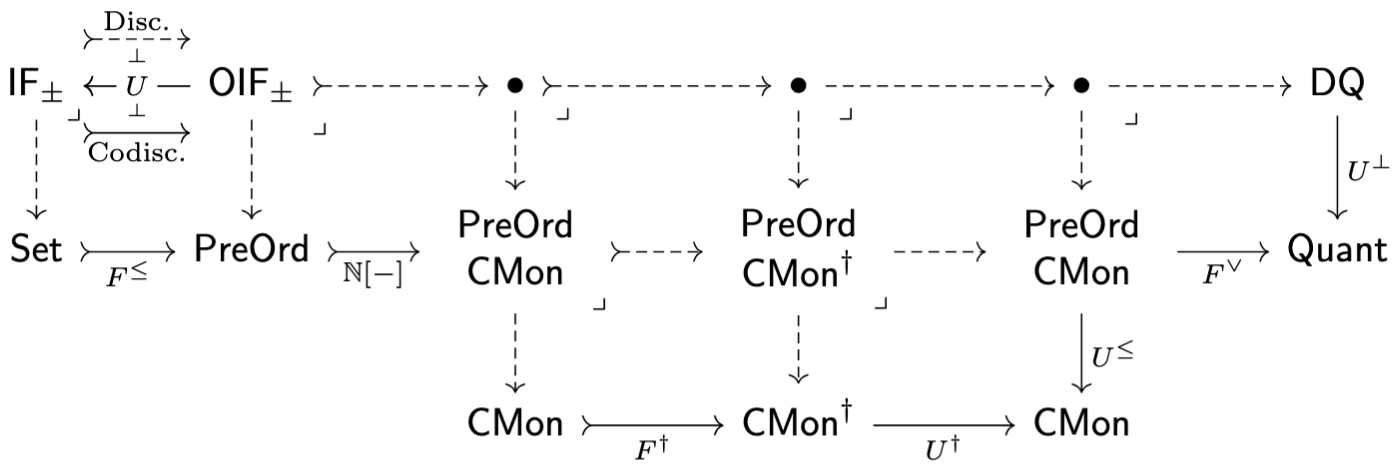
Defining a category of implication frames
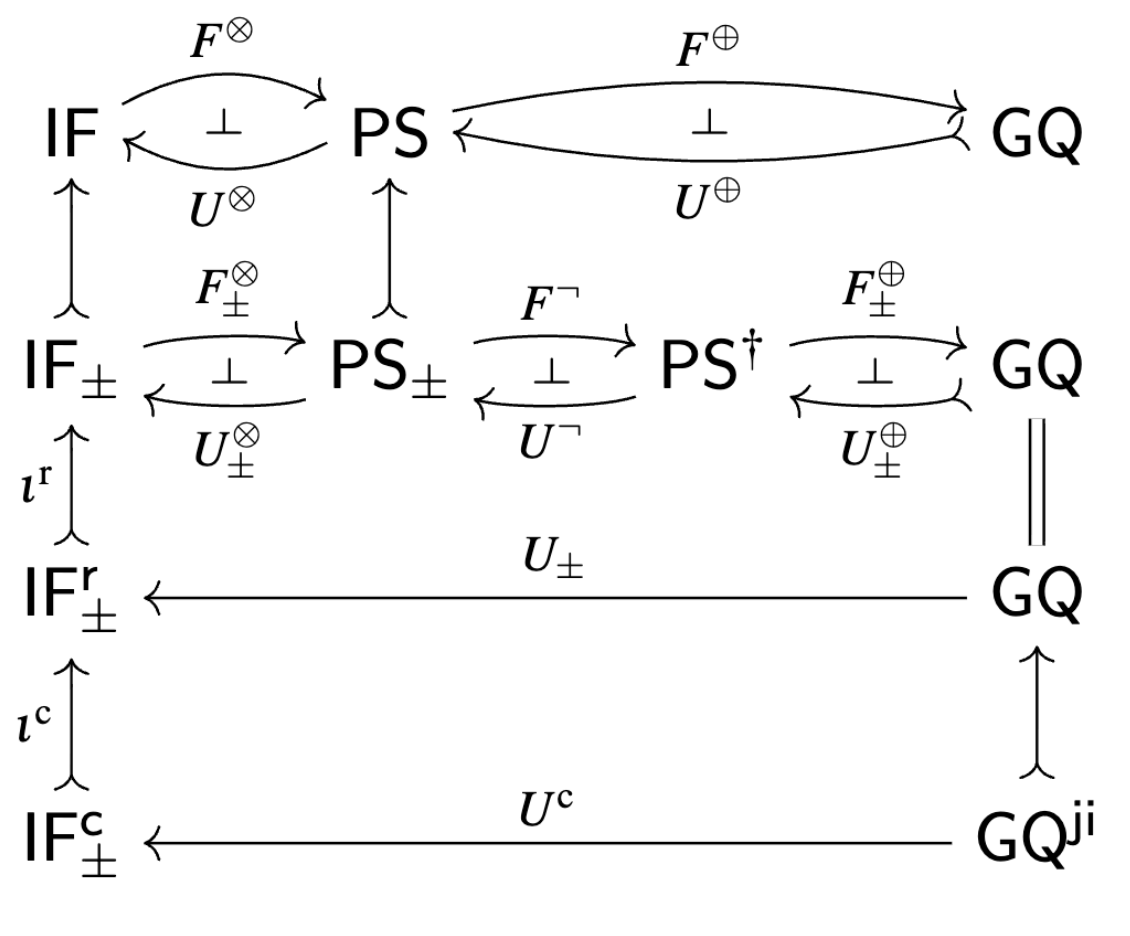
The doubling functor arises as the free involution followed by the forgetting of the involution (left adjoint to cofree involution).
This can be lifted to the preordered setting from the case of commutative monoids.
Free dialogue category implication frames
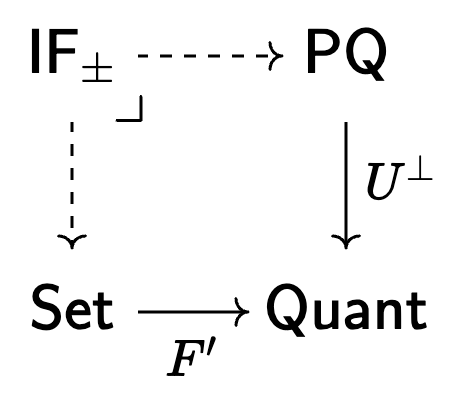
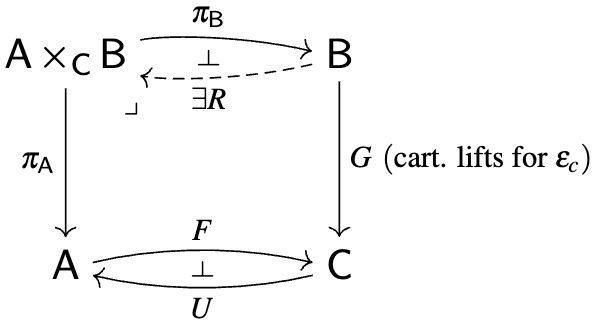
Lemma: Adjoints from pullbacks
If G has cartesian lifts \overline{\varepsilon_c} for all {\varepsilon_c\colon FU(c)\to c}, then the pullback projection \pi_\mathsf{B}\colon \mathsf{A \times_C B\rightarrow B} has a right adjoint R\colon \mathsf{B\rightarrow A \times_C B} given by R(b)\mapsto (UG(b), \operatorname{dom}(\overline{\varepsilon_{G(b)}})).
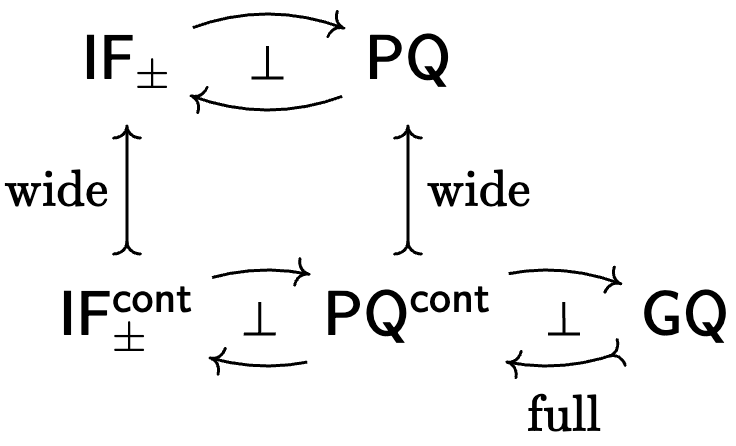
The pullback projection map \mathsf{IF_\pm\to PQ} is a left adjoint, as U^\bot is a fibration.
Free Girard quantales
Girard quantales (Q,\leq,\otimes,\bot\in Q)
\bot is a dualizing element: a=a^{\bot\bot} where {a \otimes b \leq \bot} \iff a \leq b^\bot.
If we restrict the morphisms of both \mathsf{IF}_\pm and \mathsf{PQ} to satisfy continuity,1 we freely add the structure of a Girard quantale. Let this adjunction be F \vdash U.
Adjunction unit
Let’s interpret \eta_\mathcal{X}\colon \mathcal{X}\to\widehat{\mathcal{X}}=(X',\bot') as sending a base frame to its semantic frame with a semantic consequence relation, \ \vDash.
X' elements are pairs of \mathcal{Q}:=F(\mathcal{X}) elements: (-)^{\bot\bot}-closed subsets of \mathbb{N}[X+X].
Given premises [\langle \Gamma_1^+,\Gamma_1^-\rangle,...] and conclusions [\langle \Delta_1^+,\Delta_1^-\rangle,...], we have:
\eta_\mathcal{X} sends x \in X to \langle (\{x\},\{\})^{\bot\bot}, (\{\},\{x\})^{\bot\bot}\rangle.
Progress so far
Progress towards recovering implication space semantics
We’ve now recovered:
What \mathbb{R} is: elements of the free Girard quantale \mathcal{Q}= F(\mathcal{X})
the space of semantic values (\mathbb{C}=\mathbb{R}^2=X')
the notion of semantic consequence (\bot')
the interpretation [\![ - ]\!] = \eta_\mathcal{X}\colon X \to X'.
semantic clause for negation: it’s swap! [\![ \neg A ]\!]:=\langle a_-,\ a_+\rangle
Now, what about the MALL semantic clauses? We know how to interpret \otimes,\text{⅋},\oplus,\& in a GQ.
The semantic values are pairs of elements of \mathcal{Q}, but this doesn’t have a unique Girard quantale structure.
Reflexive implication frames
Reflexive implication frames
An implication frame (X,\ \bot\subseteq \mathbb{N}[X+X]) is reflexive if \forall x \in X\colon (x,x)\in \bot.
Let \iota^{\rm r}\colon \mathsf{IF}_\pm^{\rm r} \rightarrowtail \mathsf{IF}^{\rm cont}_\pm be the full subcategory of reflexive frames.
We can restrict our previous adjunction to F_\pm\dashv U_\pm between \mathsf{IF^r_\pm} and \mathsf{GQ}.
How the codomain differs for \eta_\pm\colon (X,\bot)\to (X',\bot'):
Elements of X' are not the full \mathbb{R}^2, but the subset for which a \vDash a, i.e. a_+\otimes a_- \leq \bot.
Let \mathcal{Q}:=F_\pm(\mathcal{X}). The Girard quantale operations of \mathcal{Q}\times \mathcal{Q}^{\rm op} are closed on this subset.
\begin{align*}
&[\![ A \otimes B ]\!]&:=\langle \texttt{a}_+\otimes \texttt{b}_+,\texttt{a}_-\text{⅋ } \texttt{b}_-\rangle&& &[\![ A \oplus B ]\!]&:=\langle \texttt{a}_+\vee \texttt{b}_+,\texttt{a}_-\wedge \texttt{b}_-\rangle\\
&[\![ A \text{⅋} B ]\!]&:=\langle \texttt{a}_+\text{⅋ } \texttt{b}_+,\texttt{a}_-\otimes \texttt{b}_-\rangle&& &[\![ A \& B ]\!]&:=\langle \texttt{a}_+\wedge \texttt{b}_+,\texttt{a}_-\vee \texttt{b}_-\rangle
\end{align*}
Supralinearity
\begin{align*}
&[\![ A \otimes B ]\!]&:=\langle \texttt{a}_+\otimes \texttt{b}_+,\texttt{a}_-\text{⅋ } \texttt{b}_-\rangle&& &[\![ A \oplus B ]\!]&:=\langle \texttt{a}_+\vee \texttt{b}_+,\texttt{a}_-\wedge \texttt{b}_-\rangle\\
&[\![ A \text{⅋} B ]\!]&:=\langle \texttt{a}_+\text{⅋ } \texttt{b}_+,\texttt{a}_-\otimes \texttt{b}_-\rangle&& &[\![ A \& B ]\!]&:=\langle \texttt{a}_+\wedge \texttt{b}_+,\texttt{a}_-\vee \texttt{b}_-\rangle
\end{align*}
These are precisely the MALL semantic clauses we wanted to recover.
What is some evidence that these are good definitions?
Prop: These clauses validate the logical rules of \rm MALL
Prop: the consequence relation \vDash from \eta_\pm is supralinear.
Suppose \Gamma \vdash_{\rm MALL}\Delta. By cut-elimination for MALL, \Gamma \vdash_{\rm MALL}\Delta has a cut-free proof. The base case is that the proof is a single identity rule, which holds in \mathcal{X}' in virtue of being a reflexive implication frame. Each remaining step in the proof is a logical rule of MALL, which holds in \mathcal{X}'. Therefore \Gamma \vDash \Delta. That the valid atomic sequents are precisely \bot is a restatement that \eta_\pm is conservative.
Analogous story for classical logic
Containment implication frames
A containment implication frame (X,\bot\subseteq \mathbb{N}[X+X]) has each element x satisfying:
idempotence: \Gamma, x \vdash \Delta {\iff} \Gamma,x,x\vdash \Delta and \Gamma \vdash x,\Delta {\iff} \Gamma\vdash x,x,\Delta.
containment: all \Gamma, x \vdash x, \Delta are in \bot
When we restrict the adjunction to these frames, \eta^{\rm c} sends a frame to subset of \mathcal{Q}^2 with a natural quantale structure whose natural \otimes operation is:
[\![ A \wedge B ]\!]:=\langle \texttt{a}_+\otimes \texttt{b}_+,\ \texttt{a}_-\vee \texttt{b}_- \vee \texttt{a}_-\otimes \texttt{b}_-\rangle
These are precisely the propositional logic semantic clauses1 we wanted to recover. We’re done!
Prop: the consequence relation \vDash from \eta^{\rm c}_\pm is supraclassical.
Containment + idempotent implication frames
Containment implication frames
An element x of an implication frame (X,\bot\subseteq \mathbb{N}[X+X]) satisfies:
idempotence:1(\{x\},\{\})^\bot=(\{x,x\},\{\})^\bot and (\{\},\{x\})^\bot=(\{\},\{x,x\})^\bot.
containment: (\{x\},\{x\})^\bot=\mathcal{P}[X+X]
Let a containment implication frame be one where all elements satisfy idempotence and containment. Let \iota^{\rm c}\colon \mathsf{IF_\pm^{c}\rightarrowtail IF^{\rm r}_\pm} be the full subcategory of containment frames.
Join-idempotent Girard quantales
Let \mathsf{GQ^{ji}} be the full subcategory of \mathsf{GQ} where we restrict to join-idempotent Girard quantales, which are those for which every element q \in \mathcal{Q} can be expressed as some join of idempotent elements of \mathcal{Q}.
Idempotent restriction of a quantale
Any quantale \mathcal{Q} can be restricted to its idempotent elements \mathcal{Q}_\otimes. This has the same \otimes operation and a \overset{\sim}{\vee} b := a \vee b \vee a \otimes b.
Caveat: if \mathcal{Q} is a Girard quantale, \mathcal{Q}_\otimes need not be a Girard quantale.
Free Girard quantales from containment frames
We can restrict the F_\pm\dashv U_\pm adjunction to F_\pm^{\rm c}\dashv U_\pm^{\rm c} between \mathsf{IF^c_\pm} and \mathsf{GQ^{ji}}. For \eta_\pm^{\rm c}\colon (X,\bot)\to (X',\bot'):
Let \mathcal{Q}:=F_\pm(\mathcal{X}). Elements of X'\subseteq \mathcal{Q}_\otimes^2 are those for which a_+\otimes a_- = 0.1
The monoid operation of \mathcal{Q}_\otimes \times \mathcal{Q}_\otimes^{\vee} is closed on this subset.
[\![ A \wedge B ]\!]:=\langle \texttt{a}_+\otimes \texttt{b}_+,\ \texttt{a}_-\vee \texttt{b}_- \vee \texttt{a}_-\otimes \texttt{b}_-\rangle \quad [\![ A \vee B ]\!]:=[\![ \neg(\neg A \wedge \neg B) ]\!]
These are precisely the propositional logic semantic clauses we wanted to recover. We’re done!
Prop: the consequence relation \vDash from \eta^{\rm c}_\pm is supraclassical.
Shown by proving Lindenbaum algebra of \vDash is a Boolean algebra.
\neg and \vee satisfy the Robbins equation (McCune 1997): {\neg(A \vee B) \vee \neg (A \vee \neg B) = \neg A}
Implication space semantics
The following are all parameterized by a background implication frame (X,\mathbb{I}).
Range of subjunctive robustness operation
The range of subjunctive robustness function, (-)^*\colon {\mathcal{P}[\mathbb{N}[X+X]]\to\mathcal{P}[\mathbb{N}[X+X]]}, sends a set of candidate implications, e.g. \{(\Gamma_1,\Delta_1),...,(\Gamma_i,\Delta_i)\}, to the set {\{(\Theta,\Omega)\ |\ \forall i\colon (\Gamma_i\cup \Theta,\Delta_i\cup \Omega) \in \mathbb{I}\}}.
Implicational roles and conceptual contents
The set of implicational roles is \small \mathbb{R}:={\rm im}(\operatorname{RSR}).
The set of conceptual contents is \mathbb{C}:=\mathbb{R}^2.
Symjunction and adjunction of roles A,B \in \mathbb{R}
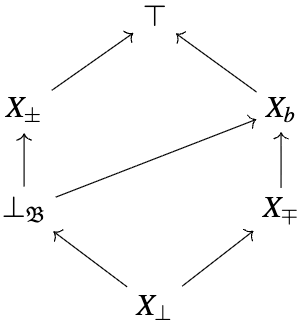
Now we can derive more inferential roles in \mathbb{R} by taking intersections of the singleton roles from the previous table, but this just yields one new role X_\bot=\{a^+,b^+\}^\bot = X_\pm\cap X_\mp.
[\![ a ]\!]=\langle \{a^+\}^{\bot\bot},\{a^-\}^{\bot\bot} \rangle=\langle X_\mp,\bot_\mathfrak{B}\rangle \qquad [\![ b ]\!]=\langle \{b^+\}^{\bot\bot},\{b^-\}^{\bot\bot} \rangle=\langle X_\pm,X_\mp \rangle
We can use the formula for semantic consequence to show that \Gamma \vdash \Delta \iff [\![ \Gamma ]\!]\vDash [\![ \Delta ]\!].
We can compute syntactically that {a,b\vdash a\wedge b} from {a,b\vdash a} and {a,b\vdash b} and {a,b\vdash a,b} in \mathcal{X}.
We also observe on the right that {[\![ a ]\!],[\![ b ]\!]\vdash [\![ a\wedge b ]\!]}.
\begin{align*}
\pi_1([\![ a ]\!]) \otimes \pi_1([\![ b ]\!]) \otimes \pi_2([\![ a \wedge b ]\!]) &\subseteq \bot_\mathfrak{B}\\
\pi_1([\![ a ]\!]) \otimes \pi_1([\![ b ]\!]) \otimes\qquad \qquad\qquad\qquad\quad& \\
\pi_2([\![ a ]\!]) \vee \pi_2([\![ b ]\!]) \vee (\pi_2([\![ a ]\!]) \otimes \pi_2([\![ b ]\!])) &\subseteq \bot_\mathfrak{B}\\
X_\mp \otimes X_\pm \otimes (\bot_\mathfrak{B}\vee X_\mp \vee (\bot_\mathfrak{B}\otimes X_\mp)) &\subseteq \bot_\mathfrak{B}\\
X_\mp \otimes X_\pm \otimes X_b &\subseteq \bot_\mathfrak{B}\\
X_\bot &\subseteq \bot_\mathfrak{B}\\
\end{align*}
\mathcal{X} satisfies “containment” (\Gamma\vdash \Delta \in \bot whenever \Gamma and \Delta overlap), so \vDash is supraclassical.
However \vDash is not monotone: we have \ \vDash [\![ b ]\!] and [\![ a ]\!]\nvDash [\![ b ]\!].
Non-idempotent example
Let X=\{\bullet\}. Multisets of X can be identified with natural numbers, thus the set of positions is \mathbb{N}^2. Define \bot_\mathfrak{B}=\{01,12\}\cup R, i.e. 0\vdash 1 and 1\vdash 2, and n\vdash n. 1
To check whether linear modus ponens is valid, we test [\![ \bullet ]\!],[\![ \bullet\multimap\bullet ]\!]\vDash[\![ \bullet ]\!], which holds because \{10\}\otimes \varnothing \otimes \{01\} = \varnothing\subseteq \bot_\mathfrak{B}. This also follows from a theorem that reflexivity of \mathcal{X} implies \vDash is supralinear.
However, note \vDash is not transitive, as \vDash [\![ \bullet ]\!] and [\![ \bullet ]\!]\vDash [\![ \bullet ]\!],[\![ \bullet ]\!], yet we also have \nvDash [\![ \bullet ]\!],[\![ \bullet ]\!].
The debate from a CT perspective
Functorial semantics: functors \mathsf{C}\to\mathsf{D} are thought of representationally: the objects of \mathsf{C} are represented by objects of \mathsf{D}. The semantic category (e.g. \mathsf{Set}) usually has nice structure (e.g. cocompleteness).
However, even without some supplied semantic category \mathsf{D}, we have a canonical interpretation of \mathsf{C} into a nice category as \widehat{\mathsf{C}}=[\mathsf{C,Set}], the free cocompletion.
So our \eta has some similarities to the Yoneda embedding, in particular because it arises from a free cocompletion.
We aren’t forced to pick exclusively between understanding \mathsf{C} ‘internally’ vs representationally.
Next steps
\mathsf{IF_\pm} is bicomplete + closed, has analogues which are \mathcal{V}-enriched
Computational implementation in Julia: ROLE.jl - Naive implementation
Frege’s context principle: we need to understand subsentential structure from the starting point of inferences between sentences.
Can represent richly-structured concepts / systems
Thank you for listening
And even more thanks to:
Kevin Carlson
David Jaz Myers
Evan Patterson
Lucy Horowitz
And the Research on Logical Expressivism (ROLE) group:
Robert Brandom, Ulf Hlobil, Ryan Simonelli, Rea Golan, Shuhei Shimamura, and others.
Future work
Ordered implication frame
An ordered implication frame is a preorder (X,\leq) equipped with a monotone map \mathbb{N}[X^{\rm op}+X]\to 2
Enriched implication frame
An enriched implication frame is a \mathcal{V}-category \mathcal{A} equipped with a \mathcal{V}-presheaf in \widehat{S[\mathcal{A}^{\rm op}+\mathcal{A}]}, where S(-) denotes the free symmetric monoidal \mathcal{V}-category.
It’s not clear how \mathcal{V}-enrichment leads to subsentential structure.
In \mathsf{Set}-enriched setting, a frame a set of substitutions between any two claimables.
There is also a set of reasons why \Gamma \vdash \Delta.
Another idea inspired by hyperdoctrines: fix a category of contexts \mathsf{C} and decompose one’s frame to a give a functor \mathsf{C \to OIF} (this requires work, there isn’t a canonical way to do it).
References
Fine, Kit. 2017. “A Theory of Truthmaker Content i: Conjunction, Disjunction and Negation.”Journal of Philosophical Logic 46 (6): 625–74.
Fodor, Jerry A, and Ernest Lepore. 1993. “Why Meaning (Probably) Isn’t Conceptual Role.”Philosophical Issues 3: 15–35.
Girard, Jean-Yves. 1995. “Linear Logic: Its Syntax and Semantics.”Proceedings of the Workshop on Advances in Linear Logic, 1–42.
Hlobil, Ulf, and Robert B Brandom. 2025. Reasons for Logic, Logic for Reasons: Pragmatics, Semantics, and Conceptual Roles. Routledge.